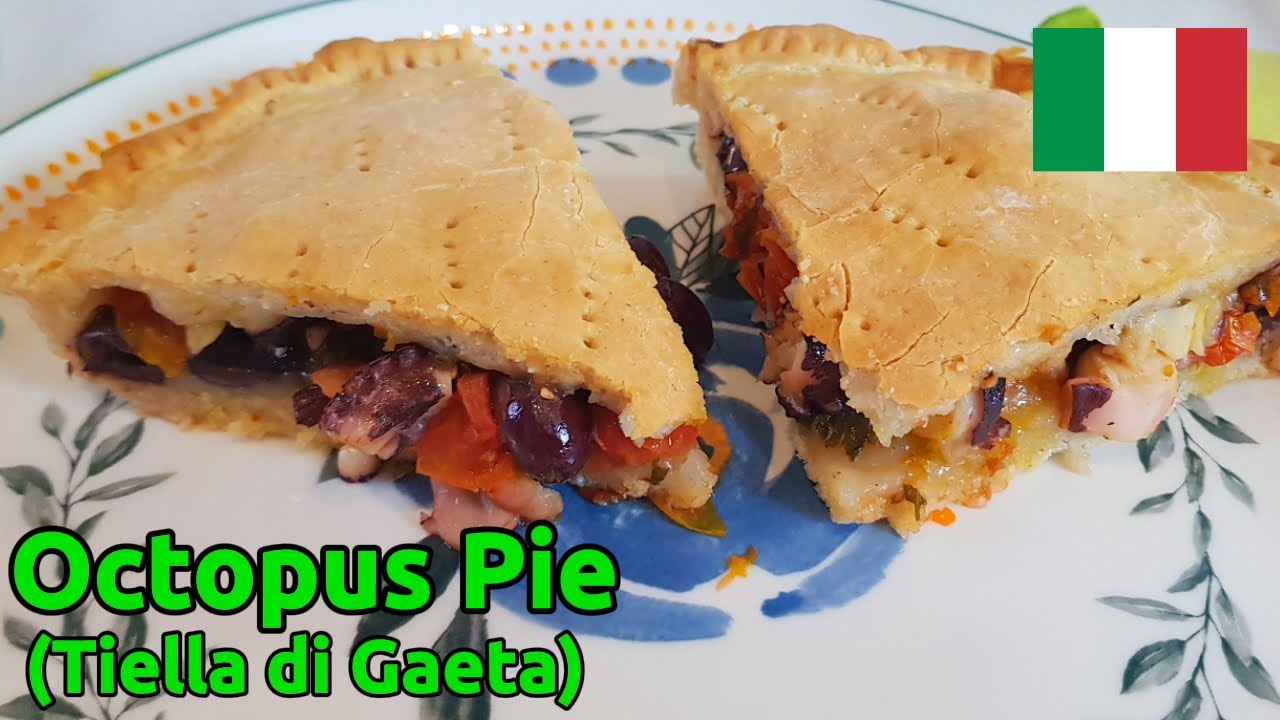
Discover the authentic taste of Octopus Pie from Italy! Enjoy a gluten-free Tiella di Gaeta seafood recipe that captures my hometown’s flavors.
Discover the Flavors of Authentic Italian Seafood Delight!
Octopus pie, or tiella di Gaeta, is a beloved dish from the region of Gaeta, Italy. This savory pie features a delicious filling made primarily of octopus, which is cooked until tender and then combined with cherry tomatoes, olives, garlic, parsley, and olive oil. The vibrant combination of flavors creates a delightful taste that showcases the essence of Italian cuisine. The filling is allowed to chill in the refrigerator for at least an hour, allowing the flavors to meld beautifully before being baked into the pie.
The dough for the pie can be made gluten-free, using a specific blend of gluten-free flour, dry yeast, olive oil, salt, sugar, and water. After kneading and letting it proof, the dough is divided into two parts. One half is rolled out and placed in a pie dish, while the other half is rolled out to cover the filling. The pie is then pierced with a fork and brushed with olive oil before baking at 200°C for approximately 35 minutes. This method results in a crispy, golden crust that complements the rich, savory filling.
Delight in a Slice of Tradition: Savor the Ocean’s Bounty with This Gluten-Free Gaeta Seafood Pie!
Hi everyone, and welcome to my channel! Join me on a trip to Italy today, and let me show you a dish from nearby my hometown, tiella di polpo, or octopus pie! Tiella di Gaeta is a pie that can also be filled with greens and olives, but this version is one of my all-time favourites, I always try to get some when I’m in Italy and I can’t wait to try it again. So, first of all, choosing the right octopus is very important. Octopus is not a common find here in the UK, but a supermarket chain recently started selling it frozen and I stocked up some for this pie and for future recipes. And it’s precisely the type I need, the so called “common octopus”, generally fished in the Mediterranean, while I believe that the.
One you normally find in the UK is curled octopus, which is generally fished locally. You can easily tell the two apart because common octopus has two rows of suckers on each tentacle, while curled octopus only has one. Also, common octopus is normally bigger and will turn to a darker colour when cooked compared to the curled octopus’s pale pink. The reason why you want to use common octopus though, is that its flesh will be tender when cooked properly, while curled octopus can often be chewy and almost rubbery at times. And this can be a deal breaker for a pie like this one. However, if curled octopus is all you can find, you can try to freeze it before you use it, or tenderize the flesh by pounding it with a meat mallet..
Additionally, dunking it in boiling water 3 times before cooking it, like I am doing, should also help. I’ve added about a tablespoon of salt to this water, so the tentacles will already absorb some of it while cooking, and I won’t need too much seasoning later on. I’ll let it simmer for about 50 minutes, but bear in mind that larger octopi… octopuses, well whatever, might take longer to cook through. That’s why I always poke it with a fork before I take it out. If the fork goes through it easily, it’s done. Now, I’ll let it cool down and I will start working on the rest of the filling. I mince a garlic clove, I chop some fresh parsley, and then the octopus..
This is 540 g of octopus, which should be just about right for a medium-sized pie. I’ll add 250 g of cherry tomatoes, sliced into quarters, 1/2 tsp of salt, and a couple of tbsp of olive oil. Lastly, I add 80 g of pitted olives. They should be Gaeta olives, which I can’t find here, so I’m using the next best thing, which is kalamata. This is so tempting already; I could eat it as it is! The reason why I prepared the filling before everything else is that I want to allow the ingredients enough time to really come together. So, I’ll cover it and transfer the bowl to the fridge where I’ll keep it for at least one hour. I can start working on the dough now. I add 300 g of flour to a bowl, 4 g of yeast,.
1 tbsp of olive oil, ½ tsp of sugar, 180 ml of lukewarm water, and 1 tsp of salt. I need to add an extra 20 ml of water for this gluten free flour, but you won’t need it if you’re using 00 or all-purpose flour. I’m done kneading, so I’ll cover it and set it aside for an hour. Before I start rolling the dough, I brush a pie dish with olive oil. This dish is 9.5 inches, or 24 cm in diameter. Now, I can divide the dough in two, but I’ll cut one half bigger than the other, and I’ll use it as the base. I roll it until it’s a couple of cm larger than the pie dish. At this point, I transfer the dough to the pie dish,.
Making sure it fits in nicely, then I trim the edges, and I spread the octopus filling all over. I roll the other half of the dough, I lay it on top, and I seal the edges. Finally, I poke all over the pie lid with a fork to let the steam out while baking, and I brush it with some olive oil. The pie now goes into the oven at 200°C for 35 minutes! Here you go, it’s ready! But I need to let it cool down for at least 10 minutes before I can cut into it. Awesome! Olives, tomatoes and octopus, does it get any more Mediterranean than this? Some people prefer a thinner crust, but I was afraid that it would break apart, on my first attempt with gluten-free flour..
I must say, not only does the crust hold, it has a nice bite too and the filling is obviously what this pie is all about. It definitely lives up to my expectations. So, what do you think? Are you going to give it a try? Let me know if you do! And if you enjoyed this video, don’t forget to hit the like button and subscribe! So, where are we going next?